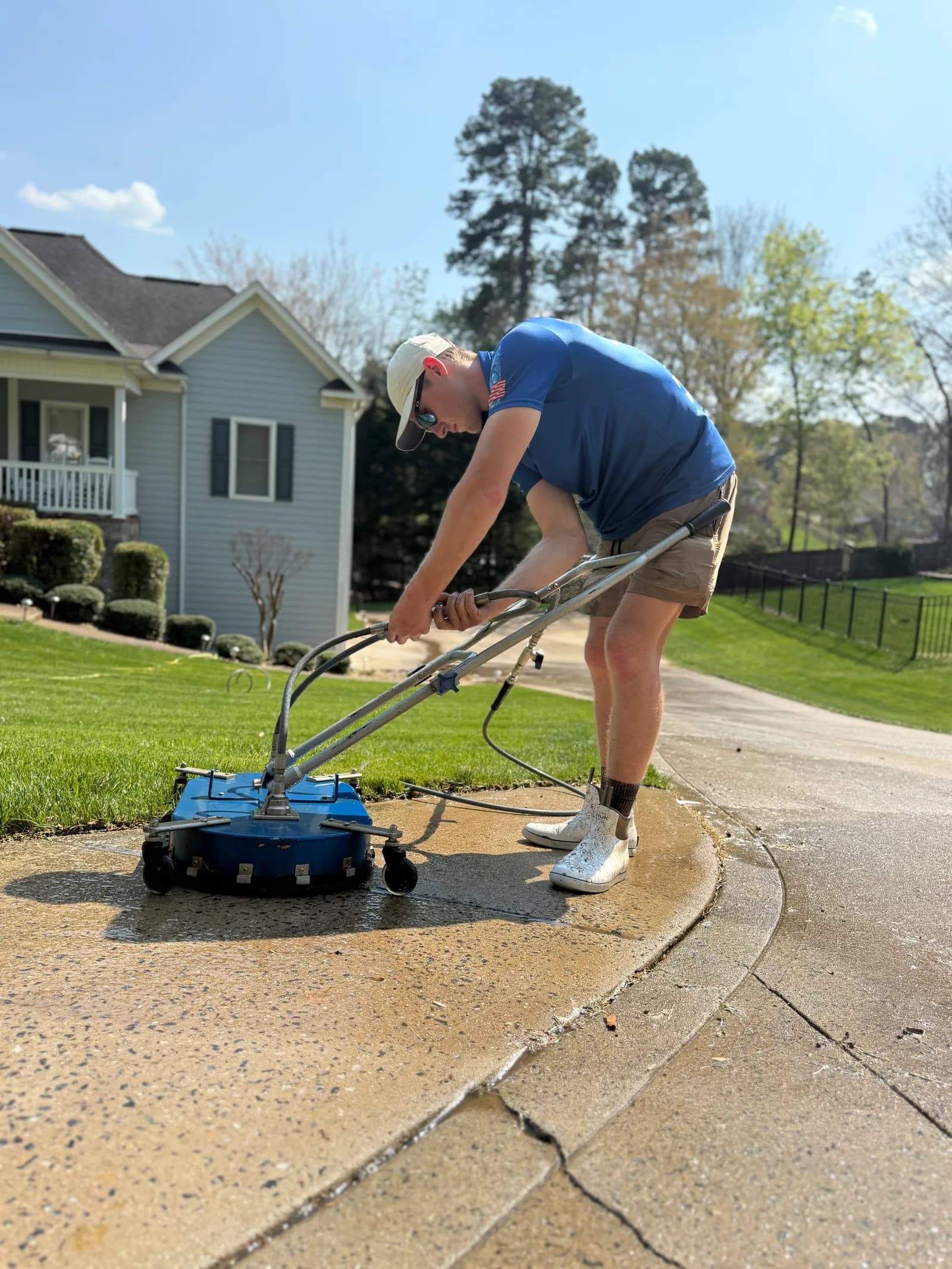
Pressure washing is one of those jobs that looks simple until you are standing in front of a stained driveway with a rented machine, watching it leave zebra stripes across the concrete. Used on the right surface with the right technique, a pressure washer is the fastest way to take years off the look of a Denver, NC home. Used on the wrong surface, it strips paint, gouges wood, and forces water where it does not belong.
This guide breaks down what actually belongs under high pressure on a typical 28037 property, what should be soft washed instead, how often our local conditions make cleaning worthwhile, and when it pays to hand the machine to someone who does this every day.
Pressure washing versus soft washing
The single most important thing to understand before you clean any exterior surface is that pressure washing and soft washing are two different tools for two different jobs. Getting this wrong is how most homeowners damage their own homes.
Pressure washing uses high-force water to physically blast grime off hard, durable surfaces. It is the right call for concrete, brick pavers, and most stone. Soft washing uses low pressure plus a biodegradable cleaning solution that kills algae, mold, and mildew at the root, then rinses gently. It is the right call for anything that water can damage or get behind: siding, roofs, painted wood, and stucco.
The rule of thumb that keeps Denver homeowners out of trouble: if it is horizontal and made of concrete or stone, you can usually pressure wash it. If it is vertical and part of the house itself, it almost always wants a soft wash instead.
What pressure washing actually fixes on a Denver home
Denver sits on clay-heavy soil in a humid pocket of Lincoln County, and that combination leaves a very specific set of stains on hard surfaces. Pressure washing, done with a surface cleaner rather than a point-tip wand, handles all of them:
- Red-clay staining. Our soil runs off in every storm and tints concrete a stubborn pink-orange. The clay works into the pores of the slab, so a surface cleaner has to pull it out, not just rinse the top.
- Mold and mildew on shaded concrete. North-facing driveways, back patios, and walkways under tree cover grow a slick green-black film that gets dangerously slippery when wet.
- Oil, rust, and tire marks. Driveways and garage aprons collect drips and scuffs that need targeted pre-treatment before the pressure pass.
- Leaf and acorn tannin. The mature oaks across East Lincoln and Westport drop debris that rots into dark tannin stains on patios and pavers.
- Pollen paste. Denver's heavy spring pollen settles into the texture of stamped concrete and paver joints and turns to a grimy film.
How often should you pressure wash in Denver?
For most Denver homes, an annual cleaning of the concrete and hard surfaces is the right baseline. Once a year keeps the clay film, mold, and tannin from building into the deeper stains that take real effort to remove.
If your driveway sits in heavy shade, backs up to woods, or is close to a busy road like NC-16 or NC-73, plan on cleaning every six to eight months. Shade and moisture grow mold faster, and road grit accelerates everything. The same logic applies to the driveway and concrete cleaning we do most often out here: the shadier and lower the spot, the faster it comes back.
Siding and roofs run on a longer schedule. A soft wash of the house once a year and a roof cleaning every two to five years is usually enough, with lakefront and heavily shaded homes landing at the more frequent end of that range.
Surfaces you should never pressure wash
This is the part that saves homeowners the most money, because the damage from pressure washing the wrong surface is rarely cheap to fix. Keep the high-pressure wand off these:
- Roof shingles. High pressure strips the protective granules off asphalt shingles and voids most manufacturer warranties. Roofs need a soft wash, the method the shingle makers actually recommend.
- Vinyl, Hardie, and wood siding. Pressure can crack vinyl, drive water behind the panels, and strip paint off wood trim. Siding gets a low-pressure soft wash.
- Stucco and dryvit. The texture is far more fragile than it looks, and a wand can blow holes straight through it.
- Windows and screens. High pressure breaks seals and bends frames. Glass gets cleaned with a pure-water system instead.
- Old or soft brick and mortar joints. Aged masonry needs chemistry and a careful touch, not brute force that erodes the mortar.
DIY versus hiring a local pro
Plenty of Denver homeowners rent a machine and clean their own driveway, and for a flat, open slab in good shape that can work out fine. The trouble starts in three places: a point-tip wand leaves visible stripes across the concrete that a surface cleaner avoids, the wrong nozzle etches lines into the slab that never come out, and the temptation to turn that same pressure on siding or a roof leads to real damage.
A pro brings a commercial surface cleaner that scrubs the whole slab evenly, the right chemistry to lift clay and kill mold at the root instead of just wetting it, and the judgment to know which surfaces get pressure and which get a soft wash. For a one-story ranch with a small driveway, DIY is reasonable. Once you are dealing with a large driveway, a stained patio, and a house that also needs washing, hiring it out usually costs less than the rental, the chemicals, and the do-over.
What our Denver pressure washing includes
We are a locally owned company based right here in Denver, working the 28037 ZIP every week. For hard surfaces, we pre-treat the area to break down clay, mold, and oil, run a commercial surface cleaner in overlapping passes for an even, stripe-free finish, hand-detail the edges and cracks, and flush the whole perimeter so debris ends up in the street instead of your garage. For the house itself, we switch to a soft wash that safely clears the algae and mildew our lake humidity grows on siding.
Most homeowners have us handle the whole exterior in one visit: driveway and walkways under pressure, siding and roof by soft wash. If you want the full picture of how we serve the area, see our Denver, NC service page, or request a free estimate and we will walk the property with you and give you an exact number before any work starts.